Suman Dutta

iLab - Portfolio
Physics+AI
Highlight cover image

Hello World !

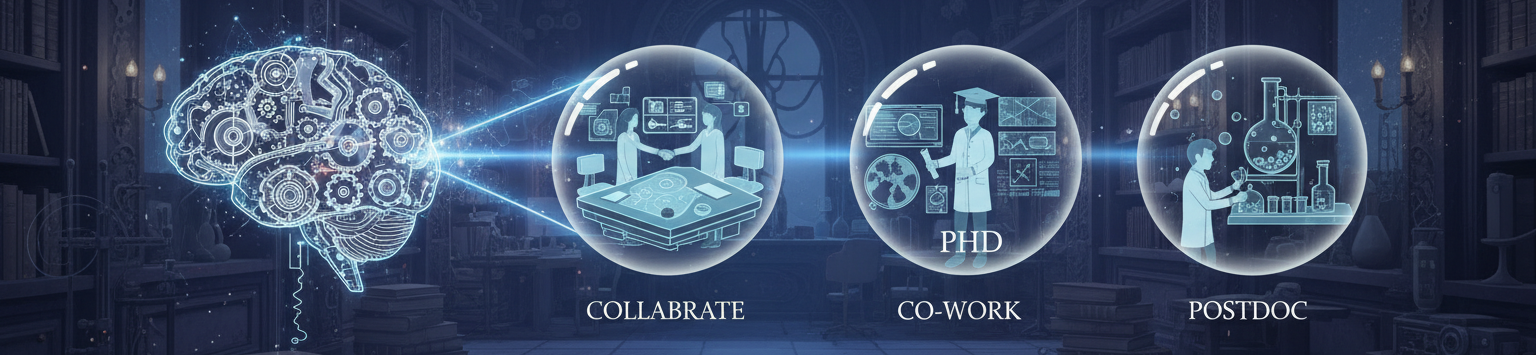
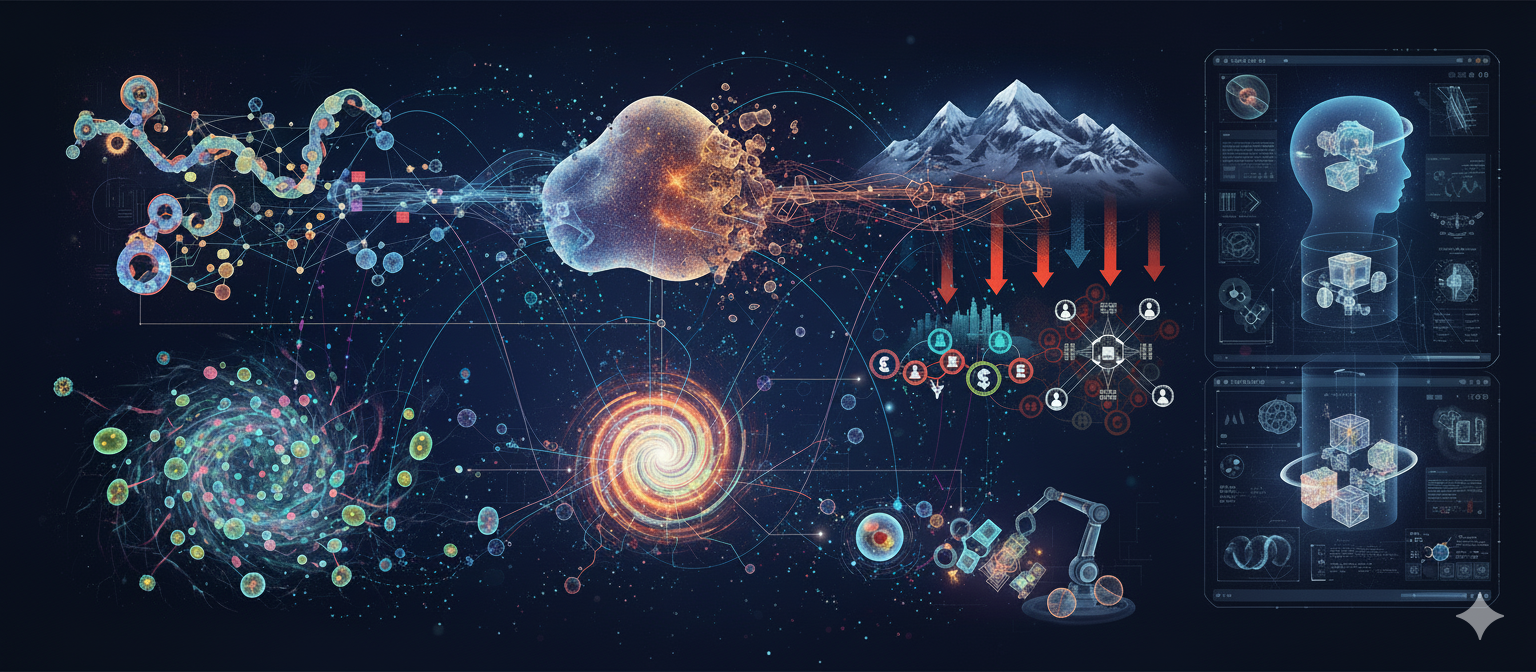
We are a group of creative researchers exploring physics at the interface of artificial intelligence, working in a deeply collaborative and interdisciplinary setting. Our goal is to understand complex systems and to see how modern computational approaches, especially deep learning, can contribute to solutions for societal good. Our main research interests include:

  • Collective Intelligence in Natural and Artificial Systems: How do large groups of individual agents—be they birds in a flock, cells in a tissue, or robots in a swarm—coordinate to achieve complex, group-level goals? We explore the physical principles behind this emergent intelligence, studying how local rules and interactions give rise to sophisticated collective behaviors in both living and engineered systems.
  • Physics of Living Matter: We view biological tissues as a form of active matter. We study the collective migration and self-organization of cells to better understand fundamental processes like wound healing, tissue development, and morphogenesis. By creating computational models that capture the interplay between cellular forces and signaling, we hope to contribute insights that could one day aid in regenerative medicine.
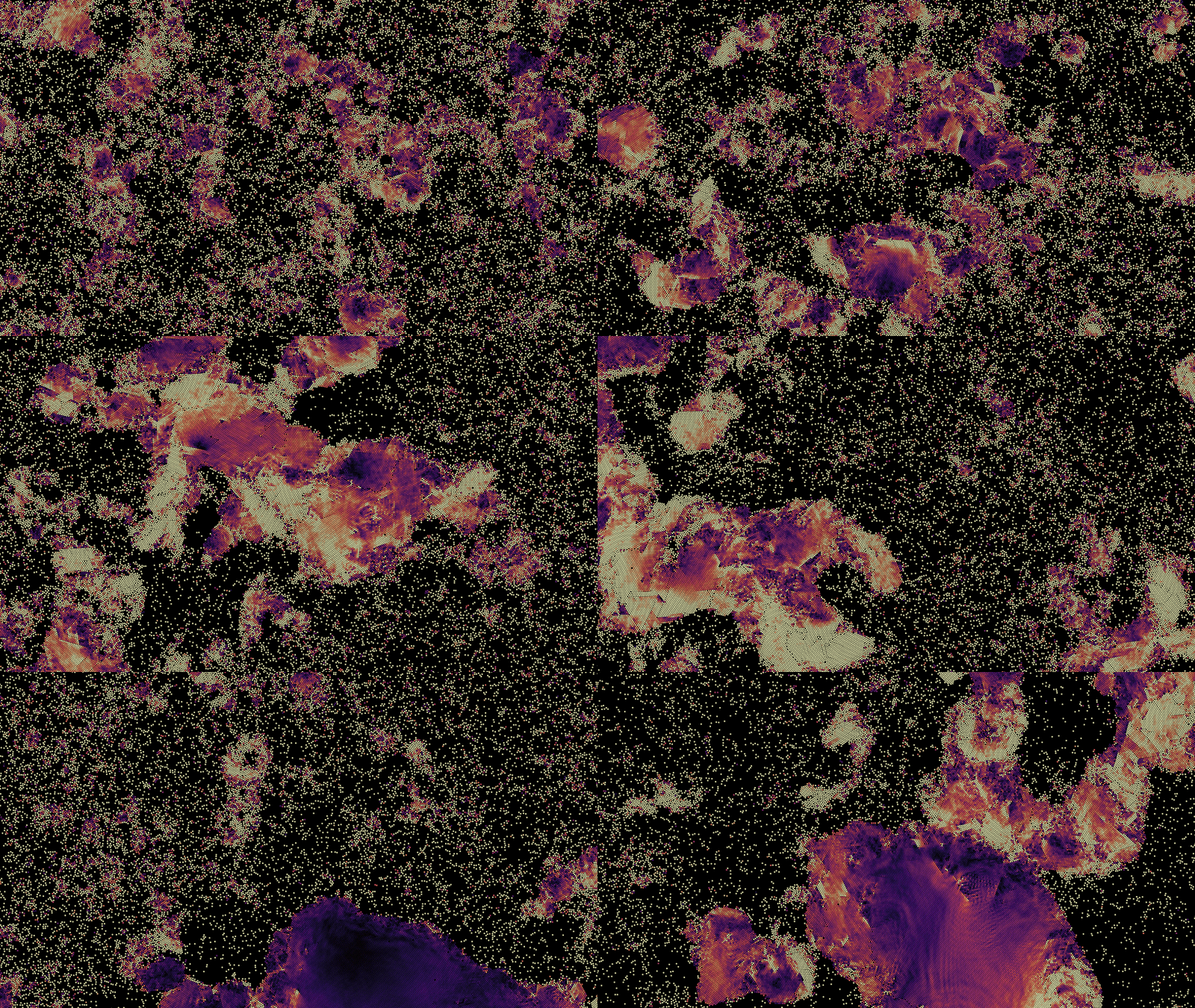
  • Mechanics of Disordered Materials: Materials like glasses and granular packings lack a perfect crystal structure, which makes predicting their behavior, particularly failure, a difficult challenge. We investigate the fundamental mechanics of these systems, applying machine learning techniques to identify subtle structural precursors to failure. Our goal is to contribute to a more predictive science of materials, which is essential for designing more resilient and safer structures.
  • AI as a Tool for Scientific Discovery: A common thread through all our research is the use of deep learning not just for prediction, but as a tool for gaining fundamental insight. We are committed to developing simple models by machine intelligence (MI). We aim to uncover the underlying physical principles our models have learned, helping us to formulate new hypotheses and deepen our understanding of the complex natural systems we study.

We thrive on a close partnership with experimentalists and other theorists, creating a dynamic environment for learning and discovery.

🌟 Highlights

  • Research Interests: Investigating the dynamics of natural and artificial complex systems, with a focus on out-of-equilibrium soft, glassy, and active matter.
  • Physics at the Interface of AI: By training models from physical systems, we integrate fundamental physical laws into novel AI models. This involves using high-performance computing and explainable AI to decode molecular information processing, predict material failure, and attempts to understand emergent behaviors in living and artificial systems.
  • Teaching and Mentoring: Engaged in teaching courses such as Mathematics for AI and Intelligent Systems, and mentoring research interns and graduate students.

🌟 Join Us

Join Us Graphic

🔬 Research Interests & Competencies

Research Expertise

  • Domain Expertise: Collective Intelligence in Living and Artificial Systems, Physics of Complex Fluids, Soft Condensed Matter.
  • Core Competencies: Creative Research, Out-of-Equilibrium Statistical Physics, Machine Learning Order Disorder.
First highlight cover image Second highlight cover image

Key Research Areas

  • Soft, Glassy, Active & Adaptable Matter
  • Physics of Flow, Glass & Living Machines
  • Material Failure and Molecular Information Processing
  • Mechanobiology, Catastrophe Science, Emergent Intelligence

Extensive Experience in

  • Soft Condensed Matter
  • High Performance Computing (Molecular Simulations)

Research within the Group

We perform extensive computer simulations, harnessing the power of High-Performance Computing (HPC), alongside statistical methods. Our aim is to develop and deploy data-driven yet inherently explainable techniques. These methods are meticulously designed to systematically investigate the intricate complex processes that drive autonomous organization and the phenomena of failure in both living and artificial systems. Our approach bridges the gap between complex data analysis and fundamental scientific understanding, ensuring our findings are not only predictive but also interpretable.

Our research endeavors delve into several key directions, offering a comprehensive exploration of complex systems:

  • Molecular Information Processing: We meticulously decode how molecular systems store, manipulate, and relay information. This involves unraveling the fundamental principles that govern adaptive behaviors observed in both natural biological networks and synthetic molecular constructs. By understanding these intricate mechanisms, we aim to engineer more sophisticated and responsive artificial systems.
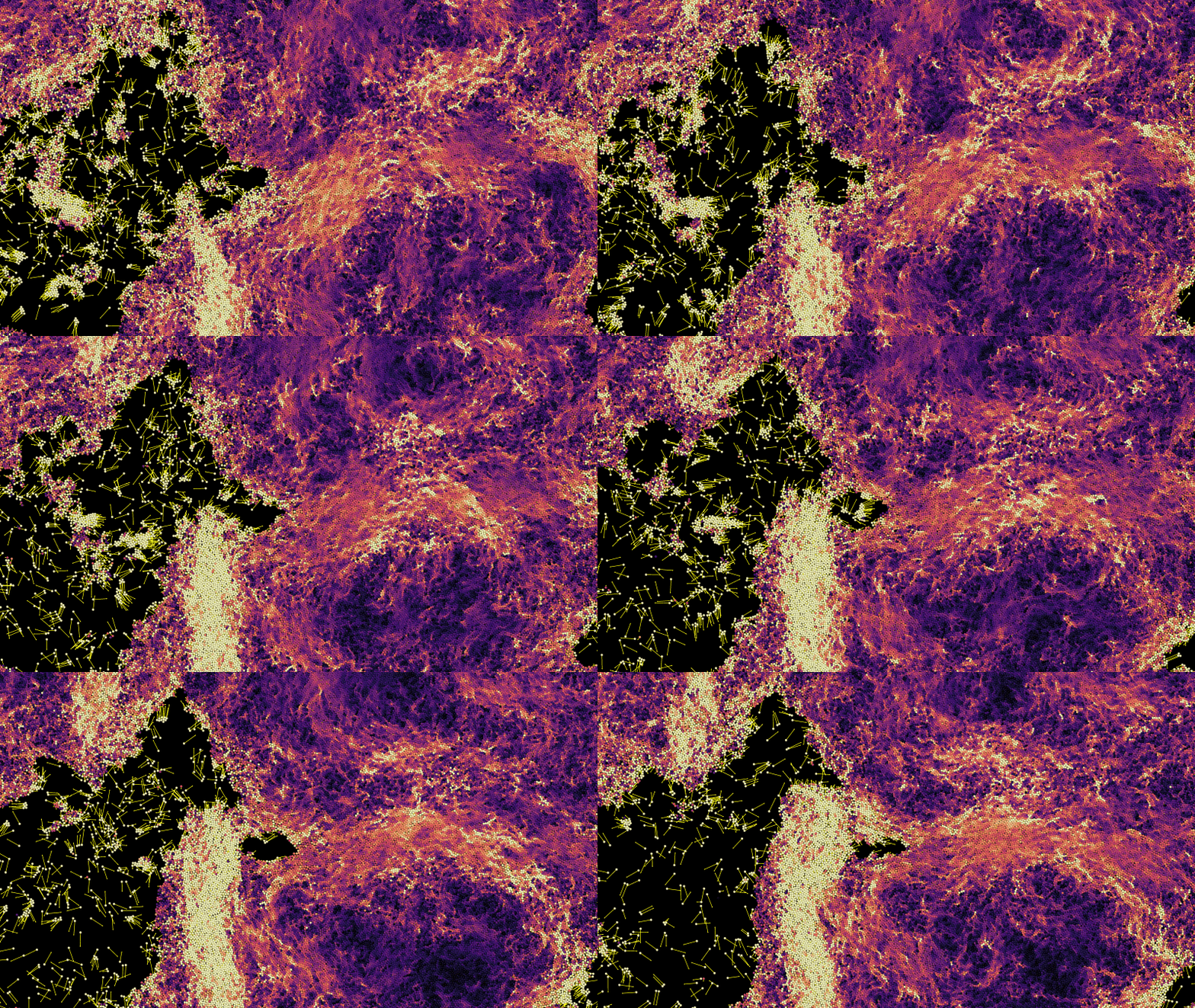
  • Cellular Migration and Turbulence: We investigate the often chaotic and dynamic patterns exhibited by migrating cells. This research focuses on understanding their collective dynamics during critical biological processes such as tissue formation, repair, and in cases of failure. By analyzing these complex movements, we gain insights into emergent behaviors and the underlying physical constraints.
  • Failure and Jamming of Amorphous Systems: A significant area of our work explores the transitions of disordered materials between fluid-like and rigid states. We aim to develop predictive models that can accurately forecast their resilience, pinpoint critical points of failure, and understand the jamming phenomena that can lead to material collapse.
  • Predicting Vulnerability and Avalanches: We develop models that capture the dynamics of critical cascades—phenomena ranging from natural avalanches to the interconnectedness of economic societies. Our goal is to forecast the likelihood and potential impact of systemic failures, thereby enabling proactive mitigation strategies.
  • Autonomous and Critical Phenomena in Living and Artificial Systems: We are deeply interested in the emergence of self-organized behaviors in systems poised at critical thresholds. By studying these systems, we aim to uncover the delicate balance between stability and adaptability, and how these seemingly opposing forces coexist to drive complex system evolution.
  • Generative Physical Intelligence: We are pioneering the development of novel generative models that are deeply integrated with the fundamental laws of physics. This research aims to create AI systems capable of not only predicting but also generating physically plausible dynamics and structures. By teaching models the principles of statistical mechanics and emergent phenomena, we seek to build intelligent agents that can autonomously discover new materials, understand system failures, and generate innovative solutions to a complex physical challenges.

📚 Publications

2026

V. Vaibhav, T. Das & S. Dutta*, Persistently Non-Gaussian Metastable Liquids, Ann. Phys. (Berlin) 538 (4), e00247(2026) [LINK]

Contribution: Corresponding author

2025

S. Santra, L. Touzo, C. Dasgupta, A. Dhar, S. Dutta, A. Kundu, P. Le Doussal, G. Schehr & P. Singh, Crystal to liquid cross-over in the active Calogero-Moser model, J. Stat. Mech. 033203 (2025) [LINK]

Contribution: Contributing author

S. Dutta*, P. Chaudhuri, M. Rao & C. Dasgupta, Activity-driven sorting, approach to criticality and turbulent flows in dense persistent active fluids, arXiv:2509.00376 (2025) [LINK]

Contribution: First and Corresponding author

2024

V. Vaibhav & S. Dutta*, Entropic timescales of Dynamic Heterogeneity in Supercooled Liquid, Phys. Rev. E (Lett.), 109, L062102 (2024) [LINK]

Contribution: Corresponding author

2023

S. Dutta, K. Martens & P. Chaudhuri, Creep response of athermal amorphous solids under imposed shear stress, arXiv:2303.04718 (2023) [LINK]

Contribution: First author

2021

C. Liu, S. Dutta, P. Chaudhuri & K. Martens, Elastoplastic approach based on microscopic insights for the steady state and transient dynamics of sheared disordered solids, Phys. Rev. Lett., 126, 138005 (2021) [LINK]

Contribution: Joint first author

2020

R. Dandekar, S. Bose & S. Dutta*, Non-Gaussian information of heterogeneity in soft matter, Europhys. Lett., 131, 18002 (2020) [LINK]

Contribution: Corresponding author

S. Dutta* & J. Chakrabarti, Length-scales of dynamic heterogeneity in a driven binary colloid, Phys. Chem. Chem. Phys., 22, 17731 (2020) [LINK]

Contribution: First and Corresponding author

2019

S. Dutta*, Microscopic insights into dynamical heterogeneity in a lane forming colloid, Chem. Phys., 522, 256 (2019) [LINK]

Contribution: Solo author

2018

S. Dutta* & J. Chakrabarti, Transient dynamical responses of a charged binary colloid in an electric field, Soft Matter, 14, 4477 (2018) [LINK]

Contribution: First and Corresponding author

2016

S. Dutta* & J. Chakrabarti, Anomalous dynamical responses in a driven system, Europhys. Lett., 116, 38001 (2016) [LINK]

Contribution: First author

2015

J. Chakrabarti & S. Dutta, Analytical form of forces in hydrophobic collapse, Chem. Phys. Lett., 620, 109 (2015) [LINK]

Contribution: Second author

💡 Teaching & Mentoring

Glimpses

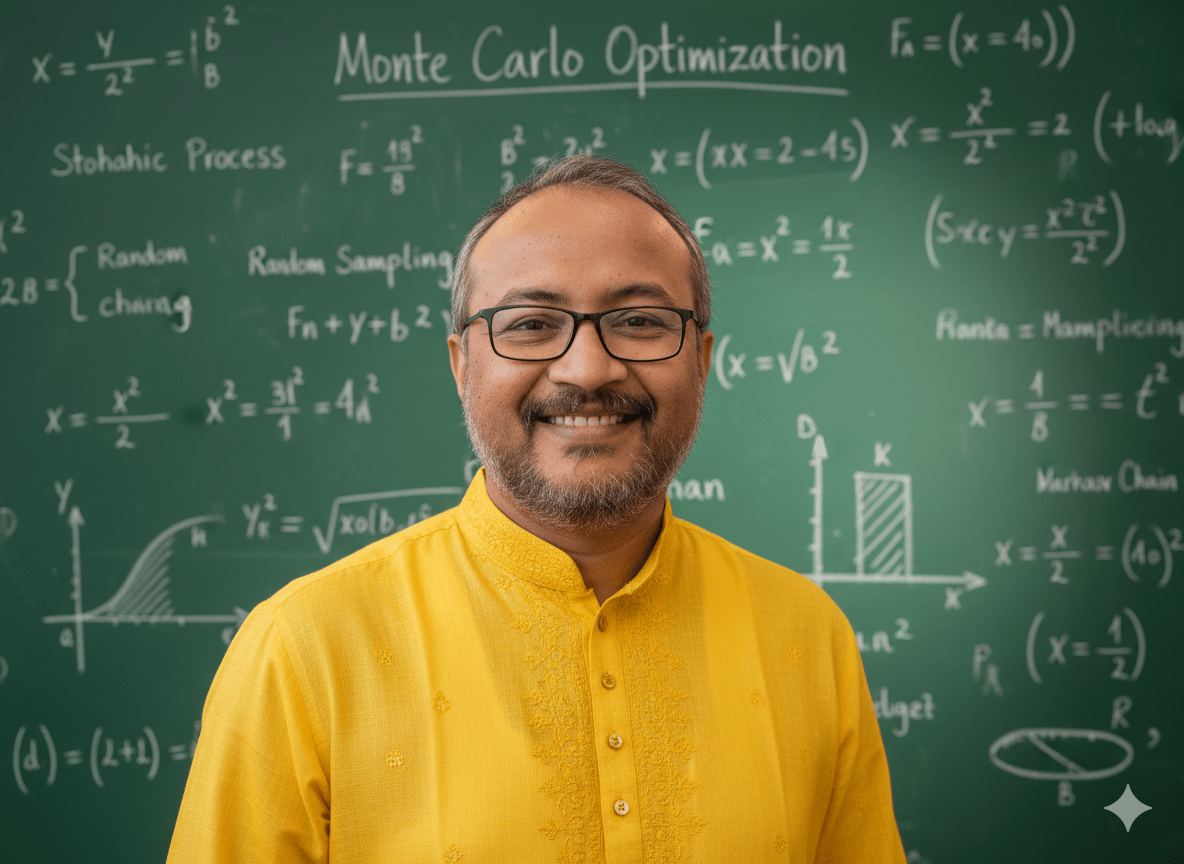
Moments from My Classes

Explore our academic engagements, mentoring programs, and pedagogical philosophy.

👨‍🏫 Academic Courses

Focus: AI, Mathematics & Material Science

Courses delivered at Amrita Vishwa Vidyapeetham and S. N. Bose National Centre for Basic Sciences.

  • Mathematics for Intelligent Systems-III (23MAT204)
  • Introduction to Material Informatics (23CHY115)
  • Mathematics for Intelligent Systems-I (23MAT106)
  • Research Methodology (PHY501)
View Course List →

🤝 Mentoring & Supervision

Role: Advisor & Co-Supervisor

Guiding research interns, Masters thesis students, and student collaborators.

Interns Thesis
View Student Profiles →

🧠 Teaching Philosophy

Approach: Interactive & Generative

Believing in "Learning by Doing" and bridging the gap between theoretical Physics and applied AI.

Read Methodology →

Courses Taught

Course Code Credit Hrs/Week Session Students TLP-Feedback
Mathematics for Intelligent System - III (B.Tech in AI & Data Science, Semester-III) 3+3 4+4 2026-27 Odd 65+66 Ongoing
Introduction to Material Informatics (B.Tech in AI & Data Science, Semester-II) 3+3 4+4 2025-26 Even 64+65 92.92%
Mathematics for Intelligent System - I (B.Tech in AI & Data Science, Semester-I) 4+4 5+5 2025-26 Odd 65+66 93.11%

Research Supervision

Research Interns

A. Jagdish, School of Physical Sciences, Amrita Vishwa Vidyapeetham (06/2025 onwards)

Student Collaborators

A. Harish, Department of Mathematics, Amrita Vishwa Vidyapeetham (06/2025 onwards)

A. Venkatraman, Department of Mathematics, Amrita Vishwa Vidyapeetham (06/2025 onwards)

P. S. Mrudula, Department of AI, Amrita Vishwa Vidyapeetham (11/2025 onwards)

Masters Thesis Co-supervision

Magnus Olsen, Understanding Non-Newtonian Materials
(Supervisor: R. Cabriolu, Norwegian University of Science and Technology, since 08/2025)

Supervision: Topical Projects
Subject Code Names Title
23CHY115 Adithya R, Ashwin Krishna V, Madhan S, Nawin K.G Prediction of Molecular Solubility
23CHY115 Mahalakshmi R, Venugopalan G, Ram Eswar P, Selva Vignesh V Semantic RAG with Specialized Embeddings
23CHY115 A. Shashank Royal, M. Dinesh Kumar, M. Sujan, K. Aravind Guptha Bio-Match: Implant Material Recommender
23CHY115 P. Manvith, M. Venkat Naidu, S. Manoj Chowdary, B. Nakul Earthquake Probability & Early Warning Analysis
23CHY115 Rithvik, Venkat, Abhishek, Grishmanth Forecasting Stress-Strain with Koopman
23CHY115 Rithvik Arulprakash, Harshith K. V, Vijayamurughan S, Vipin Sudhakar AI-Driven Dynamics in Active Glass
23CHY115 Suthasrinitha K.G, Asmitha T, Moushika S, Mirudhunya V Governing Equations of Chaotic Systems
23CHY115 J. Harini, A. Harsha Sree, B. Pavani, P. Prasad Identifying Metastable States with HAVOK
23CHY115 B. Lalith, K. Swami, M. Pranavi, N. Manoj The Sandpile Model (BTW)
23CHY115 N.V. Varshitha, A. Jahnavi, T. Varshini, B. Sai Prasanna Polymer Property Prediction Simulator
23CHY115 V.R. Yasswant, Abishek S, Y. Sanmukha Sai, U. Sudheer Convex Hull for Alloy
23CHY115 Hari Priya, Maha Sri, Neha, Prathibaa SINDy - Discovering Physics from Data
23CHY115 Moorthy Neeraj, Mortha Sathwik, Surya Charan Teja, Pavan Kalyan S.V, Dhanush Lennard-Jones System for Glass Formation
23CHY115 Sharvesh S. P, B. gurucharan, P. A. Bhavesh Jayan, Hashwin M The Butterfly Paradox: Chaos in MD
23CHY115 T.V.S.S Phanindra Guptha, Athul V.R, Nanda Kishore, M. Vittal Ocean Waves Dynamics
23CHY115 B. Sharmitha, H. Bala Sri Siva Sai Surya Tej, V. Mouli Sri, K. Bhanu Prakash AI-Based Material Recommendation System
23CHY115 D. Durga Prasad Reddy, Mukesh Reddy, G. Yaswanth Reddy, K. Praneeth, Jasmitha Failure Prediction in Amorphous Solids
23CHY115 S. Sujitkumar, M. Hemanthkumar, H. Abinavkumaran, P.V. RithikRaj Molecular Phase Dynamics using Koopman DMD
23CHY115 Kirithik B, Sankardas K.K, V. Amruth, Vishnu Prasad P Discontinuous Molecular Dynamics
23CHY115 Adharsh K, Anu R, Sidharth M, Vethavarsini A Rare Event Acceleration with Koopman-GNN
23CHY115 Akshara Sree R, Anirudh S Nair, Iniyaa Muthuselvan, Shashank Kannan The Battery Oracle
23CHY115 Harish Kumaar S, S. Sri Raghav Vatsan, Dhruv Jayesh, Prithve KC Predicting Swarm Dynamics
23CHY115 Kanish Visyanth C, Kavipranidan J.T, Navaneet K.V, Nethaaji S Radiation Damage Prediction
23CHY115 Revanth S, G Kamalesh, Jaswanth S, Elango Megabala G Graph Neural Networks for Molecules
23CHY115 K. Gayathri, P. Sri Harshini, M. Deekshitha, A. Gnana Amrutha AI-Based Inverse Material Selector
23CHY115 Rohith Meka, Kode Karrthik, Naram Divya Akhil, T. Yashwant Microstructure Evolution Prediction
23CHY115 Meenakshi Bijoy, Neelanjana J Anil, Aryananda M, Ghadige Rithika Learning Swarm Behaviour
23CHY115 U. Raghu Nandan, S. Akshaya, Nikitha, Likhit K De-noising MD Data via Hankel SVD
23CHY115 M. Harsha, M. Anudeep Reddy, P. Nihal Reddy, P. Naren Bayesian Optimization for Alloy Design
23CHY115 C. Sai Hardhik Reddy, R. Gagan Chowdhury, K. Charan Saatvikh Reddy, T. Sri Sai Deformation in Copper Crystals
23CHY115 Srikar, Sumanth, Sai Sushanth, Sai Sathwik Perovskite Solar Cells
23CHY115 Neha Saravanan, Y. Pranavi Reddy, T. Sai Varshitha Predicting Particle Mobility in Active Matter
23MAT106 Adithya R, Sai Prasanna B, Anudeep Reddy Stochastic Gradient Descent-Image Brightness Optimizer
23MAT106 Abisheik S, Ashwin Krishna V, Nakul Sharvan B, Nawin K.G Interior Point Method for Optimization
23MAT106 Raghuraman V, Vipin Sudhakar, Harshith KV, Rithvik Arul Prakash Optimization Using Sequential Quadratic Programming
23MAT106 Harish Kumaar S, Prabakar, Venkat D, Prithve K C Minimizing 2-D Lennard-Jones System via Broyden’s Good Method
23MAT106 V R Yasswant, S. Sri Raghav Vatsan, Selva Vignesh V, Madhan S Augmented Lagrangian Method for Constrained Optimization
23MAT106 P. Manvith Sharma, P. Grishmanth, P. Naren, S. Manoj Broyden’s Bad Method for Energy Minimization
23MAT106 P. Sri Harshini, K. Gayathri, M. Deekshitha, Meenakshi Bijoy Movie Recommendation System
23MAT106 S Jaswant, Revanth S, Elango Megabala G, G Kamalesh Steepest Descent Algorithm
23MAT106 Rohith Meka, Naram Divya Akhil, B. Sai Srikar, Danush Mani Yerramsetti Movie Recommendation Using SVD
23MAT106 P.S. Sathwik, V.S. Amruth Chowdary, Kirithik B, Sankar Das K.K Computational Search for Glassy States using Conjugate Gradient
23MAT106 SV Pavan Kalyan, Neeraj M, C. Jasmitha, S. Akshaya, G. Rithika Audio Compression using SVD
23MAT106 B. Sharmitha, H. Bala Sri Siva Sai Surya Tej, V. Mouli Sri, K. Bhanu Prakash Energy Minimization of 2D Particle System via L-BFGS
23MAT106 Mortha Sathwik, Surya Charan Tej B, AryaNanda M, Neelanjana J Anil Computer Glassy States via Newton-Raphson Method
23MAT106 T.V.S.S Phanindra Guptha, M. Vittal, K. Nanda Kishore, Athul V.R Lennard-Jones Potential via Nelder-Mead
23MAT106 Y. Pranavi Reddy, Neha Saravanan, T. Sai Varshitha Reddy, K.B Nikitha Krishna Optimization of Lennard-Jones via PSO
23MAT106 Nethaaji S, Navaneet KV, Kavipranidan JT, Kanish Visyanth C Computer Glassy States through Simulated Annealing
23MAT106 Prasad Reddy, Sai Praneeth, Mukesh Reddy, Yaswanth Reddy Adopted Basis Newton-Raphson Method
23MAT106 Kode Karrthik, Kella Likhith, T. Yaswanth Sai Vedadri, U. Raghu Nandan Glassy States by Instantaneous Quench (FIRE Algorithm)
23MAT106 H. Abinavkumaran, S. Sujitkumar, M. Hemanthkumar, P.V. RithikRaj Stable Particle Arrangement via Barzilai-Borwein Method
23MAT106 Vishnu Prasad, N Sai Sushanth Reddy, Hari Sumanth, Gnana Amrutha Glassy States via Instant Quenching
23MAT106 B. Lalith Hari Sainath Reddy, N. Manoj Kumar, P. Krishna Prasad, K. Swamy Powell’s Method for Energy Minimization
23MAT106 Moushika S, Iniyaa Muthuselvan, Alamuru Harsha Sree, Akshara Sree R Levenberg-Marquardt Algorithm for Glass Optimization
23MAT106 Suthasrinitha K G, Mirudhunya V, Asmitha T, Ram Eswar P RMS Propagation Optimization
23MAT106 Pavani B, Maha Sri N, Neha S, Varshini T Basin Hopping Algorithm
23MAT106 Ala Shashank Royal, M. Dinesh Kumar, M. Sujan, K. Aravind Guptha Smart Diet Planner
23MAT106 B. Lalith, N. Manoj Kumar, P. Krishna Prasad, K. Swamy Powell’s Method of Optimization
23MAT106 K. Charan Saatvikh Reddy, R. Gagan Chowdary, C. Sai Hardhik Reddy, M. Venkat Naidu Adagrad Optimization
23MAT106 Dhruv Jayesh Kansagara, Nihal Reddy P, T. Sri Sai, Y. Sanmukha Sai BFGS with Trust Region
23MAT106 J. Harini, Prathibaa, Mahalakshmi Image Compression using SVD
23MAT106 Aadharsh, Anu R, Sidharth M, Vethavarsini A Glassy States via Instantaneous Quench (TNM)
23MAT106 M. Dinesh Kumar, M. Sujan, K. Aravind Guptha, A. Sheshank Royal Smart Diet Planner (Revised)
23MAT106 Madhan Senthil Kumar, Selva Vignesh V, S. Sri Raghav Vatsan, V.R. Yasswant Augmented Lagrangian Method (ALM)
23MAT106 B. Sai Prasanna Anjaneyulu, M. Annudeep Reddy, R. Adithya Image Enhancement Using SGD
23MAT106 Mukesh Reddy, D. Durga Prasad Reddy, Yaswanth Reddy, K. Sai Praneeth Lennard-Jones via Adopted Basis Newton-Raphson
23MAT106 Anirudh S Nair, Shashank Kannan, Vijayamurughan S, G. Venugopalan The Math Behind PageRank

My Teaching Philosophy

My approach to teaching is grounded in the belief that the interface between Physics and Artificial Intelligence provides a unique playground for intuitive understanding. I emphasize:

  • Active Learning: Moving beyond lectures to include live coding sessions, simulation workshops, and "playground" style problem solving.
  • Interdisciplinary Thinking: Encouraging students to see the mathematical structures common to both quantum mechanics and machine learning.
  • Project-Based Assessment: Evaluating understanding through the creation of tangible models and tools (like our Lab Products) rather than just rote memorization.

"Education is not the learning of facts, but the training of the mind to think." - Albert Einstein

Group Leader

Profile Picture

Suman Dutta

Researcher | Intelligent Living & Artificial Systems

About Me

I am a Creative researcher in the field of Intelligent Complex Systems, with a specialization in out-of-equilibrium Complex Fluids. I investigate model dynamics of Natural and Artificial Systems, combining Statistical Physics, High Performance Computing and Machine Intelligence, with an aim to develop strategies for Generative Physical Systems.

🎓 Professional Journey

Present Affiliation

Gemini Certified Faculty
(2026-2028)

Assistant Professor (Sr. Gr.), Department of Artificial Intelligence
School of AI, Amrita Vishwa Vidyapeetham, Coimbatore HQ

Professional Research Experience

  • Post Doctoral Fellow (01/2024 – 09/2024)
    Simons Centre for the Study of Living Machines, National Centre for Biological Sciences - Tata Institute of Fundamental Research, Bangalore (Advisor: M. Rao)
  • Post Doctoral Fellow (01/2021 – 12/2023)
    International Centre for Theoretical Sciences - Tata Institute of Fundamental Research, Bangalore (Advisor: C. Dasgupta)
  • Post Doctoral Fellow (02/2018 – 12/2020)
    The Institute of Mathematical Sciences, Chennai (Advisor: P. Chaudhuri, in collaboration with K. Martens)

Visiting Researcher Experience

  • Fluvial Mechanics Laboratory Indian Statistical Institute (Kolkata, IN)
  • Department of Physics Indian Institute of Science (Bangalore, IN)
  • Department of Physics Indian Institute of Science Education and Research (Bhopal, IN)
  • Laboratoire Interdisciplinaire de Physique Université Grenoble Alpes (Grenoble, FR)
  • Institut für Theoretische Physik II - Soft Matter Heinrich-Heine-Universität (Düsseldorf, DE)

Education

  • Ph.D in Physics (08/2012 – 01/2018)
    Department of Chemical, Biological and Macromolecular Sciences, S. N. Bose National Centre for Basic Sciences, Kolkata (Degree awarded by University of Calcutta)
    Thesis: Numerical Studies on the Dynamics of Soft Matter Systems (Advisor: J. Chakrabarti)
  • M.Sc in Physical Sciences (08/2010 – 07/2012)
    S. N. Bose National Centre for Basic Sciences (Degree awarded by West Bengal University of Technology, Kolkata)

📫 Connect

📢 Outreach & Community

Engaging with the scientific community and the public to demystify Physics and AI.

🗣️

Talks

Talks/Presentations

  • International: 3+
  • National: 10+
  • Total: 26+
🌍

Science Popularization

October 31, 2025 -- Story writing by human-machine collaboration. Participation: 115 Students

February 6, 2026 -- International Mini-Workshop -- 125 Minutes (Online). Participation: 106

🏆

Competitions

August 28–29, 2025-- The Class Hackathon on the theme "AI for Greener Future". Participation: 23 Groups (Each consisting of 6 Members)

March 20, 2026-- Class hackathon -II. Participation: 9 Groups (Each consisting of 4-6 Members)

Milestones

Human+AI Collaboration

In a fusion of logic and creativity, we conducted an experimental initiative in the Autumn of 2025, challenging first-year BTech(AID) students to move beyond the mechanics of AI to the artistry of generation. The resulting anthology compiles 115 distinct narratives, representing a massive coordination of human imagination amplified by Large Language Models. This collection showcases a remarkable spectrum of themes, refracting a single premise into genres ranging from the futuristic sci-fi of The Neural Vault and ZeroTrace to the philosophical introspection of synthetic intelligence. Demonstrating how artificial tools can yield storytelling, we present the book: "Tales from the Hidden Layers — An Anthology of Neural Symphonies" (115 Stories from 115 Student coauthors from BTech AID S1 batch, 748 Pages).

✨ Latest News

Siddharth M and MVS Praneeth has successfully completed the summer internship at the Department of Physics, SRM University.
Suman delivered a talk at the Department of Physics of Complex Systems, S. N. Bose National Centre for Basic Sciences, Kolkata: Persistently Non-Gaussian Metastable Fluids
Moushika S selected for ICTS-TIFR Summer Course: Dynamical Systems in Neuroscience
Archit Harish joined the Institute of Mathematical Sciences, Chennai
Completed Project: Development of a Proof-of-Concept Multimodal Agentic AI System for Advanced Geological Well Log Analysis (PI: Abhijith A, Project in partnership with Telesto Energy Pvt. Ltd. via The Directorate of Corporate & Industry Relations, Amrita Vishwa Vidyapeetham, Coimbatore (2025-2026) (PI: Abhijit A., CoPI: Sai N Sundarakrishna, T. Subeesh and S. Dutta
Publication: Persistently Non Gaussian Metastable Liquids, V. Vaibhav, T. Das and S. Dutta, Ann. Phys. (Berlin), 538 (4), e00247 (2026)
Oral presentation in International Mini-Workshop - 125 Minutes: Optimal Diet Plannar, M. Dinesh Kumar, M. Sujan, K. Aravind Guptha and A. Sheshank Royal
International Mini-Workshop - 125 Minutes was organised at School of AI (Coordinators: Dr Milton Mondal, Ayan Banerjee and Suman Dutta).
Suman delivered a talk at the Institute of Mathematical Sciences, Chennai: Persistently Non-Gaussian Metastable Fluids
EuroHPC Benchmark Access awarded for LUMI clusters (9th Fastest Supercomputer Globally) (PI: Raffaela Cabriolu, CoPI: Suman Dutta)
Archit Harish selected for the Biophysical Society/ICTS-TIFR flagship Meeting: Spatial Organizations of Biophysical Functions. He presented a poster -- Learning Micro-flocking Dynamics in Living Machines by Hybrid Machine Intelligence
Agnevesh Jagdish selected in the ICTS-TIFR/Google flagship school: Data Science: Probabilistic and Optimization Methods II.
Oral presentation by Archit in International Conference: Machine Learning Material Heterogeneity at Micro-scale, A Harish, A Jagdish, A Venkatraman, S Dutta, International Conference on Advanced Materials and Green Technologies, MPD34; 74 (2025)
Suman Dutta joined the School of AI, Amrita Vishwa Vidyapeetham, as Assistant Professor (24 March, 2025).

🧑‍🏫 Live Class Room

🔒 Access Restricted

Please enter the passcode to view course materials.

🧪 Lab Products

🤖 Aadri 2.0: Conversational AI for Customary Profiles

AADRI – An Intelligent Conversational AI for Academic Profiles (v2.0)

🔹 Team

  • Lead Developer: Dr. Suman Dutta, School of AI, Amrita Vishwa Vidyapeetham
  • Quality Testing: BTech AID (Core) students
  • Consultants & Reviewers: Experts from TCS, Cognizant, and University of Luxembourg

🔹 Project Synopsis

AI system engineered for the interactive presentation of academic profiles. Utilizing the Google Gemini engine and Retrieval-Augmented Generation (RAG) architecture, it transforms static information base into dynamic, query-driven user experiences. The platform ensures heightened accuracy, engagement, and personalization in professional digital self-presentation.

🔹 Colloquial Abstract

Aadri can be conceptualized as an intelligent assistant that articulates your academic contributions with the fluency of an informed colleague. Rather than navigating a conventional, static document, users engage through direct inquiry, receiving precise and user-centric responses. It functions as a personalized navigational tool for one's research portfolio, pedagogical experience, and professional accomplishments.

🔹 Purpose

  • To make academic profiles interactive, accessible, and engaging.
  • To help users (students, collaborators, institutions) explore a researcher’s work through natural conversation.
  • To set a new standard for how academics present themselves digitally.

🔹 Mobile Demonstration 📱

Evaluate the application's real-time conversational capabilities on the go, in the playground subpage. Read the: White Paper

📝 AtoGRAD: OMR Solutions for Class-based Tests

AtoGRAD is an innovative Optical Mark Recognition (OMR) solution designed to streamline and automate the grading process for classroom-based tests. More details coming soon!

🔹 Team

To be announced.

🔹 Abstract

Details about the technology and application will be available shortly.

🔹 Purpose

  • To provide a fast, accurate, and cost-effective OMR solution for educators.
  • To reduce the manual effort and time spent on grading multiple-choice exams.
  • To offer instant analytics and performance reports for students and instructors.

🩺 MedScriptAI: Intelligent Medical Documentation

MedScriptAI – Automated Clinical Scripting and Analysis Engine

🔹 Team

To be announced.

🔹 Project Synopsis

MedScriptAI utilizes advanced natural language processing to transcribe and analyze clinical interactions. By automating documentation, it allows healthcare professionals to focus more on patient care and less on administrative tasks.

🔹 Purpose

  • To reduce clinician burnout by automating electronic health record (EHR) entries.
  • To ensure high accuracy in medical transcription and prescription generation.
  • To provide real-time clinical decision support based on patient history.

🤝 Research Collaborators

Jaydeb Chakrabarti (Senior Professor, S N Bose National Centre for Basic Sciences, Kolkata, IN)
Pinaki Chaudhuri (Professor, The Institute of Mathematical Sciences, Chennai, IN)
Kirsten Martens (CNRS Researcher, University of Grenoble Alpes, Grenoble, FR)
Chandan Dasgupta (Honorary Professor, Indian Institute of Sciences, Bengaluru, IN)
Madan Rao (Senior Professor, National Centre for Biological Sciences -TIFR, Bengaluru, IN)
Vinay Vaibhav (Post Doctoral Fellow, University of Goettingen, DE)
Raffaela Cabriolu (Associate Professor, Norwegian University of Science and Technology, NO)
Tamoghna Kanti Das (Assistant Professor, WPA-NanoLSI - Kanazawa University, JP)
AM Parvez Biswas (Solution Architect - Enterprise Systems, Data & Integration, Tata Consultancy Services, IN)

🏆 Awards & Recognition

  • Project Awarded: EUROHPC-Joint Undertaking Benchmark Access (2025-2026) (PI: Raffaela Cabriolu, CoPI: S. Dutta).
  • Project Awarded: Development of a Proof-of-Concept Multimodal Agentic AI System for Advanced Geological Well Log Analysis (PI: Abhijith A, Project in partnership with Telesto Energy Pvt. Ltd. via The Directorate of Corporate & Industry Relations, Amrita Vishwa Vidyapeetham, Coimbatore) (PI: Abhijit A., CoPI: Sai N Sundarakrishna, T. Subeesh and S. Dutta) (2025-2026).
  • Best Oral Presenter at the Condensed Matter and Statistical Physics Symposium, Presidency University (August 2024).
  • Visiting Research Grant from the Indo-French Centre for the Promotion of Advanced Research (IFC-PAR/CEFIPRA) (2019, 2018).
  • Post BSc Integrated PhD Research Fellowship (2010-18).
  • National Merit Scholarship (2004).

🎮 Swarm Intelligence

Unleash the swarm. Take control of the artificial 'intelligence' and guide its trajectory toward the target in the simulation below. Acknowledgement: Harish Kumaar S, S. Sri Raghav Vatsan, Neelanjana. J A, Aryananda M, M. Bijoy, Ghadige R, D. Jayesh, Prithve KC, A. Jagdish (Ongoing)